
EN 17492:2026 Mandate Starts 1 June 2026 for Touchless Bathroom Systems





The European Committee for Standardization (CEN) has confirmed that EN 17492:2026 — the new safety and hygiene performance standard for commercial touchless restroom facilities — will become fully mandatory across the EU on 1 June 2026. This regulation directly impacts manufacturers, exporters, and suppliers of sensor-activated faucets and dispensers, high-speed jet hand dryers, and restroom odor/air treatment systems targeting the CE-marked market.
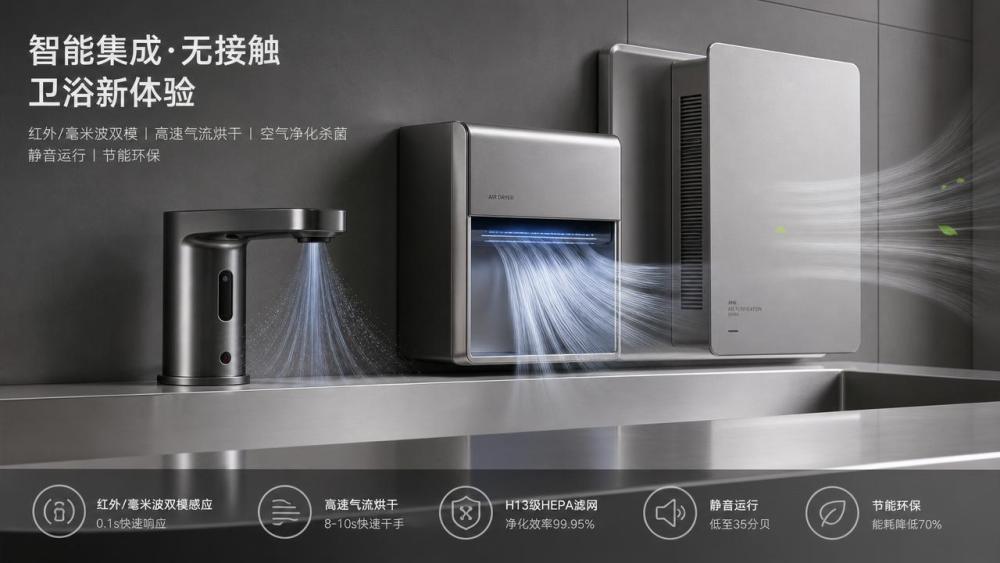
Confirmed Regulatory Timeline and Scope
The CEN officially adopted EN 17492:2026 under the title Commercial Touchless Sanitary Facilities — Safety and Hygiene Performance Requirements. As of 1 June 2026, all newly placed-on-market products falling within its scope — namely Sensor Faucets & Dispensers, High-speed Jet Hand Dryers, and Restroom Odor/Air Systems — must demonstrate full conformity. Three mandatory technical requirements are introduced: microbial aerosol suppression ≥ 99.9%, dual-mode redundant sensing (infrared + millimeter-wave), and sound pressure level ≤ 32 dB(A) under normal operating conditions. Non-compliant products will be prohibited from CE marking and market access in the European Economic Area.
Supply Chain Impact Across Key Roles
Export-Oriented Trading Companies
These firms face immediate implications for shipment clearance and customs classification. Post-1 June 2026, proof of EN 17492:2026 certification — not just CE self-declaration — will be required at point of entry. Documentation gaps may trigger border rejections or extended inspection delays.
Raw Material and Component Suppliers
Suppliers of infrared sensors, mmWave modules, antimicrobial coatings, and low-noise motor assemblies must align material specifications and test reports with the new standard’s performance thresholds. Traceability documentation (e.g., batch-level microbial suppression validation) is now a prerequisite for downstream certification.
Contract Manufacturers and OEMs
Manufacturers must revise design validation protocols, especially for sensor response reliability under variable lighting, humidity, and ambient temperature (service conditions). Functional safety testing now includes failure-mode analysis of single-sensor fallback scenarios — a shift from prior single-modality verification.
Logistics and Certification Support Providers
Third-party testing labs, notified bodies, and technical documentation consultants must update service offerings to cover aerosol suppression testing per ISO 16000-18 and acoustic measurement per ISO 3744. Lead times for full EN 17492:2026 certification are expected to extend by 4–6 weeks due to newly mandated multi-condition environmental validation.
Key Compliance Actions for Enterprises
Immediate Certification Gap Assessment
Companies should cross-map existing CE technical files against EN 17492:2026’s Clause 5 (hygiene), Clause 6 (sensing reliability), and Clause 7 (acoustic emissions). Prior EN 16895 or EN 15042 certifications do not substitute for EN 17492:2026 compliance.
Component-Level Validation and Sourcing Review
Procurement teams must verify whether current infrared sensors meet dual-mode redundancy architecture requirements — including independent power paths and signal arbitration logic. Motor suppliers must provide certified noise data under real-world airflow loads, not just no-load conditions.
Technical Tender Alignment for Public Procurement
Many EU public tenders for healthcare, transport, and municipal infrastructure already reference EN 17492:2026 in draft specifications. Bidders must ensure their technical proposals include validated test reports for all three core metrics — particularly aerosol suppression under simulated high-occupancy airflow patterns.
Production and Delivery Schedule Adjustment
Given typical certification lead times and potential redesign iterations, firms placing first shipments after March 2026 should initiate testing no later than Q4 2025. Delayed submission risks inventory write-offs or contract penalties in time-bound projects.
Industry Observation: Beyond Compliance to System Integration
Analysis shows EN 17492:2026 signals a structural shift from component-level safety standards to system-level hygiene assurance. What deserves closer attention is how the 99.9% aerosol suppression requirement effectively raises the bar for air-handling integration — demanding co-engineering between dryer airflow dynamics, duct acoustics, and odor filtration media. Observably, this favors vertically integrated manufacturers over pure-assembler models. It is more appropriate to understand this as a de facto consolidation driver in the commercial touchless restroom sector, where compliance cost increases are projected to disproportionately affect SMEs lacking in-house EMC or microbiological testing capability.
Toward a Hygiene-Centric Market Framework
This mandate marks a pivotal step in embedding evidence-based infection control into built-environment infrastructure standards. Rather than representing a temporary regulatory hurdle, EN 17492:2026 reflects an enduring recalibration of performance expectations — where ‘touchless’ no longer implies ‘safe by default’, but demands quantifiable, testable, and auditable hygiene outcomes. Stakeholders should treat compliance not as an endpoint, but as the baseline for next-generation restroom system design.
Source Transparency and Verification Guidance
This article synthesizes the provided information: title, event date (2026-06-01), and official summary confirming EN 17492:2026’s mandatory status. Specific official source links were not provided in the input and should be verified continuously. Stakeholders are advised to monitor updates from CEN, the European Commission’s NANDO database for notified bodies, and forthcoming guidance documents from national market surveillance authorities — particularly regarding transitional arrangements, enforcement interpretation of ‘placed on the market’, and acceptable test methodologies for aerosol suppression validation.
Related News
- 00
0000-00
Michigan Offers Over $4 Million in Grants for Electric Garbage Truck Purchases - 00
0000-00
High-Pressure Pumps for Sewer Jetting: Matching Flow and Pressure to Pipe Size - 00
0000-00
Smart Waste Stations for Airports: Assessing Sorting Accuracy and Throughput - 00
0000-00
Changi Airport Reorders Cleaning Robots as Chinese Maker Reaches 40-Plus Markets
Weekly Insights
Stay ahead with our curated technology reports delivered every Monday.
Related Recommendations
Explore Industrial SW designed for smart manufacturing and automation. Improve efficiency, streamline operations, and support digital transformation.