
US EPA Updates ENERGY STAR Label Rules for Commercial Pressure Washers





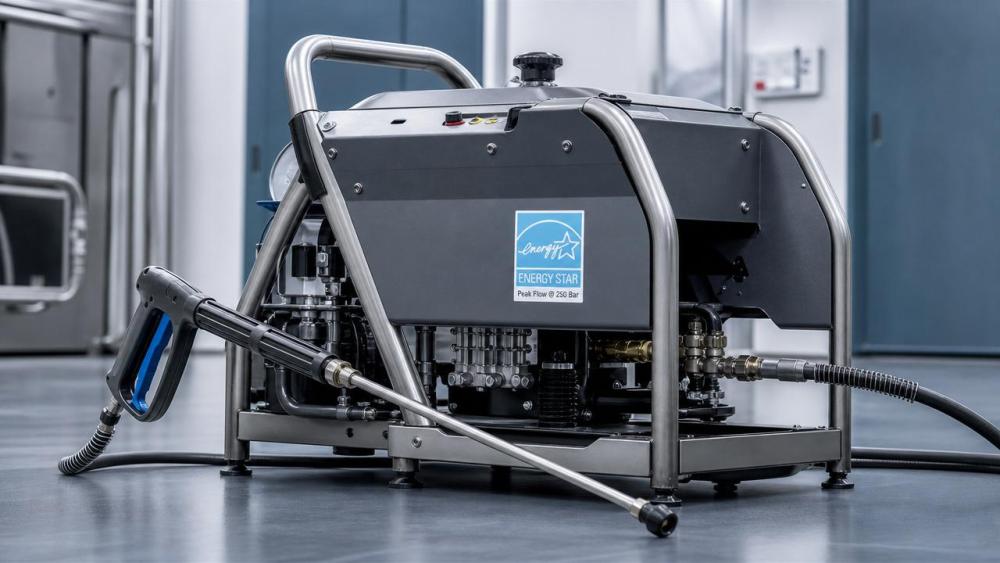
On May 30, 2026, the U.S. Environmental Protection Agency (EPA) will implement revised ENERGY STAR certification requirements for commercial high-pressure cleaning equipment. The update introduces new efficiency thresholds for dual-temperature (hot/cold) units, mandates disclosure of ‘Peak Flow @ 250 Bar’ on labels, and requires prominent display of the updated energy label on packaging and user manuals. Exporters, manufacturers, and distributors serving the U.S. commercial cleaning equipment market should take note — particularly those engaged in OEM, ODM, or direct export operations.
Event Overview
The U.S. EPA issued the final rule on May 28, 2026, amending the ENERGY STAR® certification criteria for commercial pressure washers. Effective May 30, 2026, the rule applies to all units shipped from origin countries on or after that date. It establishes separate minimum efficiency performance standards for hot/cold dual-mode models, requires measurement and labeling of peak water flow at 250 bar, and mandates visible placement of the updated ENERGY STAR label on product packaging and instruction documents. The rule does not apply retroactively to orders placed before May 30, 2026, but affects technical terms in new contracts negotiated after the rule’s publication.
Industries Affected by the Update
Direct Exporters and OEM/ODM Manufacturers
These entities face immediate compliance obligations for shipments destined for the U.S. market. Because the rule applies to goods departing origin countries on or after May 30, 2026, production scheduling, labeling workflows, and test documentation must align with the new thresholds before that date. Non-compliant units risk rejection at U.S. customs or loss of ENERGY STAR eligibility — a key factor in federal and municipal procurement decisions.
Component Suppliers and Subassembly Providers
Suppliers of pumps, heating modules, flow control valves, and pressure sensors may see revised specification requests from OEMs. The introduction of distinct efficiency thresholds for hot/cold models implies tighter tolerances for thermal efficiency and flow consistency under high-pressure conditions. Suppliers supporting U.S.-bound models should anticipate updated performance validation requirements tied to the 250-bar flow metric.
Distribution and Channel Partners
Importers, brand owners, and regional distributors must verify label compliance on incoming shipments and ensure updated marketing materials reflect the new labeling requirements. Mislabeling — including omission of the ‘Peak Flow @ 250 Bar’ value or incorrect placement of the ENERGY STAR mark — may trigger enforcement actions or limit eligibility for energy-efficiency incentive programs administered by utilities or state agencies.
What Relevant Companies or Practitioners Should Focus On Now
Confirm alignment with the May 30, 2026, shipment cutoff
Verify production timelines and logistics plans to ensure all units intended for the U.S. market depart origin facilities on or after May 30, 2026, with full compliance documentation — including third-party test reports verifying peak flow at 250 bar and model-specific efficiency calculations.
Review and update technical specifications for hot/cold models
Separate efficiency thresholds now apply to dual-temperature units. Manufacturers should re-evaluate current model certifications and assess whether existing designs meet the new standard — especially under combined thermal and hydraulic load conditions.
Validate label placement and content against EPA’s final guidance
The rule specifies ‘prominent position’ for the ENERGY STAR label on both packaging and user manuals. Companies should audit physical mock-ups and digital documentation to confirm font size, contrast, proximity to other markings, and inclusion of the required ‘Peak Flow @ 250 Bar’ statement — as defined in the final rule text.
Adjust contract language for new orders
While the rule is not retroactive, new commercial agreements signed after May 28, 2026, should explicitly reference compliance with the updated 2026 ENERGY STAR criteria — including flow measurement methodology and labeling requirements — to avoid ambiguity during delivery or audit.
Editorial Perspective / Industry Observation
Observably, this update signals a shift toward more granular, application-specific energy performance evaluation — moving beyond aggregate input power to include real-world operational metrics like flow at standardized pressure. Analysis shows the EPA is treating hot/cold pressure washers not as variants of a single category, but as functionally distinct products requiring differentiated benchmarks. This reflects broader regulatory trends in commercial equipment, where duty-cycle relevance increasingly drives test protocols. From an industry standpoint, the rule functions less as an isolated compliance event and more as an early indicator of how future ENERGY STAR revisions may incorporate multi-mode performance verification across other categories. Continued monitoring of EPA’s implementation guidance — particularly regarding test lab accreditation and flow measurement repeatability — remains advisable.
This rule marks a procedural tightening rather than a fundamental policy shift. Its immediate impact lies in operational execution — not strategic redirection — and its significance grows in proportion to a company’s exposure to U.S. public-sector procurement channels or utility-administered rebate programs. For most stakeholders, it is better understood as a targeted labeling and verification requirement than as a broad-based efficiency mandate.
Information Sources
Primary source: U.S. Environmental Protection Agency (EPA), Final Rule – ENERGY STAR Certification Criteria for Commercial Pressure Washers, published May 28, 2026. Pending clarification on laboratory accreditation procedures and flow test protocol details; these elements are noted as subject to ongoing EPA guidance updates.
Related News
- 00
0000-00
Michigan Offers Over $4 Million in Grants for Electric Garbage Truck Purchases - 00
0000-00
High-Pressure Pumps for Sewer Jetting: Matching Flow and Pressure to Pipe Size - 00
0000-00
Smart Waste Stations for Airports: Assessing Sorting Accuracy and Throughput - 00
0000-00
Changi Airport Reorders Cleaning Robots as Chinese Maker Reaches 40-Plus Markets
Weekly Insights
Stay ahead with our curated technology reports delivered every Monday.
Related Recommendations
Explore Industrial SW designed for smart manufacturing and automation. Improve efficiency, streamline operations, and support digital transformation.