
U.S. EPA Enforces New ENERGY STAR® Labeling for Commercial Pressure Washers





Effective June 1, 2026, the U.S. Environmental Protection Agency (EPA) has implemented revised ENERGY STAR® certification requirements for commercial high-pressure cleaning equipment—marking a significant shift in energy efficiency and emissions compliance for manufacturers and exporters serving the U.S. federal and state green infrastructure markets.
Key Regulatory Requirements Now in Force
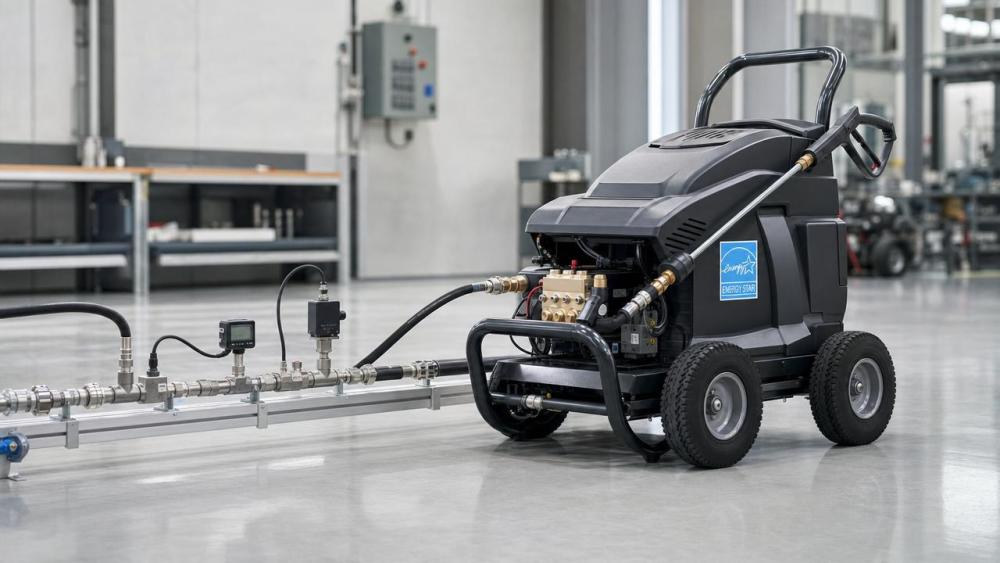
The EPA’s ENERGY STAR® Commercial Pressure Washers Version 3.0 specification took effect on June 1, 2026. Under this rule, all commercially sold cold- or hot-water pressure washers with input power of 5 kW or greater must undergo standardized energy performance testing and bear the official ENERGY STAR® label. The minimum required efficiency metric—expressed as pressure × flow rate per unit power (MPa·L/min/kW)—is set at 1.85. Additionally, diesel-powered units must meet a stringent NOx emission limit of ≤0.2 g/kWh. Non-compliant units are prohibited from federal government procurement and state-level green infrastructure projects.
Impacts Across the Supply Chain
Export-Oriented Equipment Manufacturers
Manufacturers exporting to the U.S. must now integrate ENERGY STAR® V3.0 validation into product development and pre-market testing workflows. Units previously certified under older versions (e.g., V2.0) do not grandfather in—re-certification is mandatory. This affects production timelines, test lab capacity planning, and documentation readiness for customs and procurement verification.
Raw Material and Component Suppliers
Suppliers of high-efficiency pumps, low-NOx diesel combustion systems, and precision pressure-flow control valves face increased demand for components validated against V3.0 test protocols. Procurement specifications from OEMs are expected to explicitly reference MPa·L/min/kW performance thresholds and NOx reporting requirements—shifting technical sourcing criteria.
Contract Manufacturers and Assemblers
Firms engaged in contract manufacturing must ensure final assembly lines support calibration traceability, label application compliance, and integration of certified subcomponents. Firmware updates for digital flow/pressure monitoring—and associated verification records—are now part of quality gate requirements prior to shipment.
Logistics and Compliance Support Providers
Third-party conformity assessment bodies, labeling service providers, and regulatory consultants must align their offerings with EPA’s updated test procedures (e.g., ANSI/ASHRAE Standard 117-based methodology) and documentation templates. Clients increasingly require bundled services covering test coordination, label design approval, and procurement eligibility verification.
Actionable Steps for Affected Companies
Verify ENERGY STAR® V3.0 Certification Status
Confirm whether existing models meet the new MPa·L/min/kW ≥1.85 threshold and—where applicable—the diesel NOx limit. Retesting may be required even for models previously bearing the ENERGY STAR® label under earlier versions.
Update Technical Documentation and Tender Submissions
Revise product datasheets, technical proposals, and bid responses to explicitly declare V3.0 compliance—including test reports issued by EPA-recognized laboratories. Federal and state RFPs now routinely require ENERGY STAR® V3.0 certification as a mandatory bidding requirement.
Assess Supply Chain Readiness for Low-Emission Components
Evaluate availability and lead times for certified low-NOx diesel engine modules or electric drive alternatives. Diesel model producers should initiate supplier qualification for Tier 4 Final–equivalent or cleaner aftertreatment systems aligned with the 0.2 g/kWh ceiling.
Align Labeling and Packaging with EPA Guidelines
ENERGY STAR® labels must be affixed visibly on the unit and included in user manuals and e-commerce listings. Label size, font, color, and placement follow strict EPA visual identity rules—non-conforming labels invalidate certification status.
Industry Perspective: Beyond Compliance Toward Systemic Efficiency
Analysis shows that this update reflects a broader policy trajectory: shifting from voluntary energy labeling toward enforceable procurement gateways. Observably, the MPa·L/min/kW metric signals a move beyond simple wattage reduction to system-level hydraulic efficiency—rewarding optimized pump-motor-valve integration rather than component-level upgrades alone. What deserves closer attention is the convergence of energy and emissions criteria: for the first time, a single ENERGY STAR® specification binds both efficiency and NOx limits, effectively raising the technical bar for diesel-powered commercial cleaning equipment. It is more appropriate to understand this as an early indicator of cross-regulatory harmonization between EPA’s Office of Air and Office of Energy Efficiency.
Strategic Implications for Market Access
This regulation does not merely introduce a new label—it redefines market access conditions for a $1.2 billion U.S. commercial pressure washing segment. While federal procurement represents a direct enforcement channel, state green infrastructure programs (e.g., those funded under the Bipartisan Infrastructure Law) are rapidly adopting ENERGY STAR® V3.0 as a de facto eligibility filter. Consequently, non-compliance carries cascading consequences: loss of public-sector revenue, reduced competitive positioning in mixed public-private tenders, and potential reputational risk among sustainability-conscious commercial clients.
Source Transparency and Ongoing Monitoring
This article synthesizes the event title, effective date (June 1, 2026), and summary description provided by the user. Specific official source links were not provided in the input and should be verified continuously. Stakeholders are advised to monitor updates from the U.S. EPA ENERGY STAR® program website, the Department of Energy’s Appliance and Equipment Standards Program, and forthcoming guidance on test method implementation, label enforcement protocols, and state-level adoption timelines.
Weekly Insights
Stay ahead with our curated technology reports delivered every Monday.
Related Recommendations
Explore Industrial SW designed for smart manufacturing and automation. Improve efficiency, streamline operations, and support digital transformation.