
Vietnam Mandates Chinese Origin Proof for AI Sorting Kiosks





Vietnam’s new regulatory requirement—effective 10 June 2026—introduces stringent origin verification for imported commercial AI vision sorting kiosks, directly impacting cross-border trade, supply chain transparency, and compliance workflows in the environmental technology and smart recycling sectors.
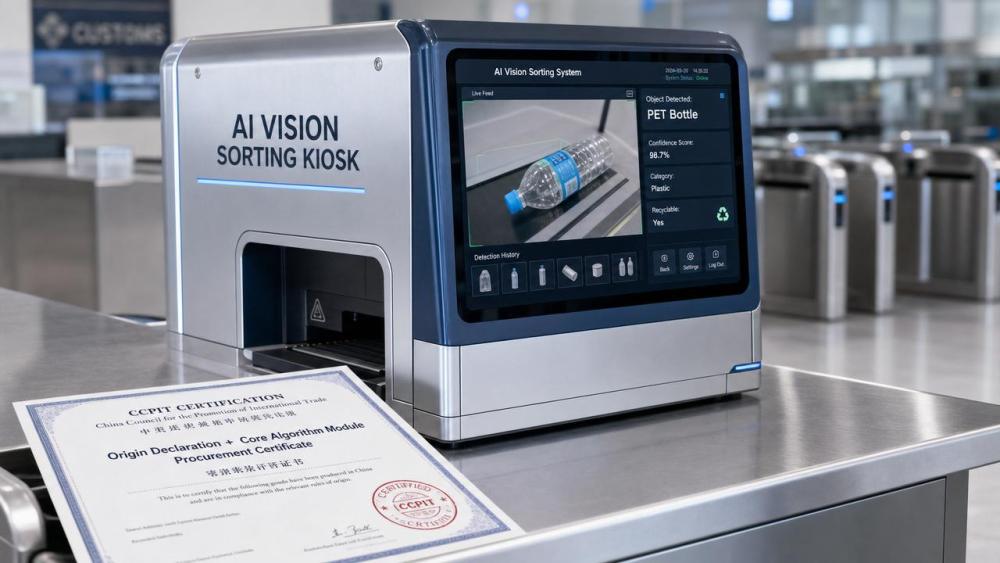
New Import Requirement Effective 10 June 2026
On 28 May 2026, Vietnam’s Ministry of Industry and Trade (MOIT) issued Official Notice No. 128/TB-BCT, mandating that all imports of AI Vision Sorting Kiosks into Vietnam must be accompanied by a CCPIT-certified document titled Origin Declaration + Core Algorithm Module Procurement Certificate. Enforcement begins on 10 June 2026. Customs authorities will specifically verify the country of origin for three critical components: image recognition chips, training datasets used in AI models, and edge computing units. This measure supports Vietnam’s broader ‘Localisation Rate for Intelligent Equipment’ policy framework administered by Vietnam Customs.
Impact Across Supply Chain Roles
Direct Exporters and Trading Firms
Companies exporting AI sorting kiosks from China—or transshipping via third countries—must now secure dual-layer certification before shipment. The added documentation step extends clearance lead time by 5–7 working days, increasing inventory carrying costs and complicating just-in-time delivery schedules.
Component Sourcing and Procurement Entities
Firms procuring image recognition chips or pre-trained datasets from non-Chinese suppliers face requalification risks if final assembly occurs in China. Traceability documentation for each dataset source and chip fabrication site must be retained and submitted—not only for the end product but for individual modules.
Contract Manufacturers and System Integrators
OEMs and system integrators assembling kiosks in China must maintain granular records of component provenance, including wafer fab locations and cloud infrastructure regions where datasets were hosted or processed. Edge computing unit manufacturing sites must be explicitly declared—even if subcontracted.
Logistics and Compliance Service Providers
Freight forwarders and customs brokers must now coordinate early with CCPIT-accredited certification bodies to validate document authenticity and alignment with MOIT’s technical interpretation of ‘core algorithm module’. Delays in certificate issuance may cascade across shipment batches.
Key Compliance Actions for Enterprises
Verify CCPIT Certification Eligibility Early
Not all Chinese manufacturers qualify automatically for the required CCPIT-issued Origin Declaration + Core Algorithm Module Procurement Certificate. Eligibility depends on documented traceability of algorithm development, data sourcing, and hardware integration—requiring internal audit readiness ahead of submission.
Map Component-Level Origin for Three Critical Elements
Enterprises must conduct a full bill-of-materials (BOM) review covering image recognition chips (including foundry location), training datasets (country of collection, annotation, and hosting), and edge computing units (assembly and firmware origin). Mixed-origin configurations may trigger additional scrutiny.
Adjust Lead Times and Contract Clauses
Procurement agreements and delivery schedules should incorporate the 5–7 working day customs processing extension. Contracts with Vietnamese partners should clarify responsibility for documentation delays, especially when algorithm updates or hardware revisions occur post-certification.
Prepare for Technical Documentation Audits
Customs may request supporting evidence beyond the certificate—including dataset licensing agreements, chip procurement invoices with manufacturer stamps, and firmware build logs. Digital archiving of these materials is strongly advised.
Industry Observation: Beyond Compliance, Toward Algorithm Sovereignty
Analysis shows this requirement reflects a broader regional shift—not merely toward hardware localisation, but toward sovereign control over AI model provenance and data lineage. What deserves closer attention is how Vietnam’s focus on training data origin signals emerging regulatory expectations for AI-enabled industrial equipment across ASEAN. From an industry perspective, manufacturers investing in modular, jurisdictionally transparent algorithm architectures—and maintaining auditable data supply chains—will gain competitive advantage in multiple emerging markets applying similar traceability logic.
Strategic Implication for Global Smart Recycling Infrastructure
This regulation does not signal market closure—but rather a recalibration of entry requirements toward verifiable technical sovereignty. For exporters, success hinges less on price or performance alone, and more on demonstrable, certifiable supply chain integrity at the algorithmic level. It is more appropriate to understand this as an inflection point where AI hardware compliance converges with data governance maturity.
Source Attribution and Monitoring Guidance
This article is generated exclusively from the user-provided title, event date (2026-06-10), and summary text. Specific official source links were not provided in the input and should be verified continuously. Stakeholders are advised to monitor upcoming MOIT implementation guidelines, CCPIT certification protocols, and updates from Vietnam Customs on acceptable formats for dataset origin declarations. Ongoing observation is recommended for sector-specific tender documents and enforcement precedents in Q3 2026.
Related News
- 00
0000-00
Michigan Offers Over $4 Million in Grants for Electric Garbage Truck Purchases - 00
0000-00
High-Pressure Pumps for Sewer Jetting: Matching Flow and Pressure to Pipe Size - 00
0000-00
Smart Waste Stations for Airports: Assessing Sorting Accuracy and Throughput - 00
0000-00
Changi Airport Reorders Cleaning Robots as Chinese Maker Reaches 40-Plus Markets
Weekly Insights
Stay ahead with our curated technology reports delivered every Monday.
Related Recommendations
Explore Industrial SW designed for smart manufacturing and automation. Improve efficiency, streamline operations, and support digital transformation.