
U.S. EPA Energy Labeling Rule Takes Effect for Commercial Pressure Washers





Effective May 30, 2026, the U.S. Environmental Protection Agency’s (EPA) Commercial Pressure Washer Energy Labeling Rule enters into force, imposing mandatory energy labeling requirements on all hot and cold pressure washers sold in the U.S. market — directly affecting manufacturers, exporters, and distributors in the commercial cleaning equipment sector.
Regulatory Requirements Now in Force
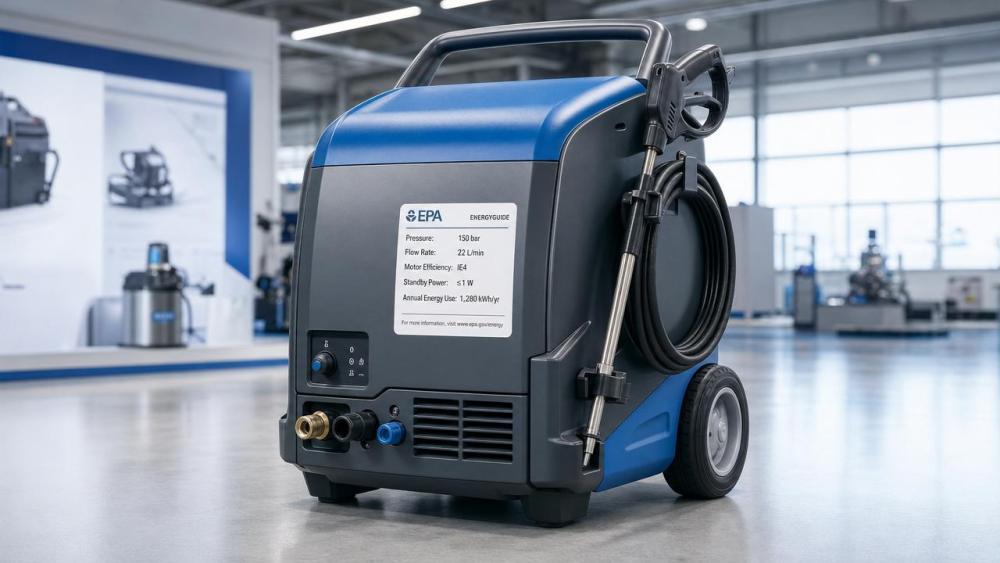
The EPA’s Commercial Pressure Washer Energy Labeling Rule became effective on May 30, 2026. It requires all hot and cold pressure washers offered for sale in the United States to bear an official EPA energy label displaying: rated pressure (in bar), flow rate (in L/min), motor efficiency (IE4 or higher), standby power consumption (≤1 W), and estimated annual energy consumption (in kWh/yr). Noncompliant units risk suspension of import authorization by the Federal Communications Commission (FCC) and civil penalties from the Federal Trade Commission (FTC).
Impact Across the Supply Chain
Export-oriented trading companies
These firms must now verify label compliance before shipment, as customs clearance and post-entry inspections may trigger holds or rejections. Label misalignment with product specifications could delay deliveries and incur rework or disposal costs.
Raw material and component suppliers
Suppliers of motors, pumps, and control modules face heightened demand for IE4-grade motors and low-standby-power electronics. Procurement specifications must now explicitly reference compliance with EPA labeling parameters — especially motor efficiency class and standby power thresholds.
Equipment manufacturers
Manufacturers must update product documentation, test reports, and labeling workflows. Units previously certified to older efficiency benchmarks may require redesign or retesting to meet both IE4 motor requirements and ≤1 W standby power — particularly for models with integrated heating elements or smart controls.
Supply chain service providers
Logistics, labeling, and regulatory consulting partners must adapt labeling application protocols, storage practices (to prevent label damage), and documentation archiving to support traceability and FTC audit readiness — including retention of test reports verifying annual energy consumption calculations.
Key Compliance Actions for Enterprises
Validate motor efficiency and standby power certification
Confirm that all motors are independently tested and certified to IE4 (or higher) per IEC 60034-30-1, and that full-system standby power is verified at ≤1 W under applicable operating conditions — not just at the motor level.
Update technical documentation and labeling files
Revise product datasheets, user manuals, and e-commerce listings to reflect EPA-mandated metrics. Labels must be physically affixed, legible, durable, and positioned adjacent to the main control panel per EPA guidance — digital-only labels are not permitted.
Align with FCC and FTC enforcement timelines
Understand that FCC import suspension applies upon detection of noncompliant labeling during entry review, while FTC penalties may follow consumer complaints or marketplace audits. Pre-shipment verification and third-party label conformity assessments are strongly advised.
Review supplier declarations and test report validity
Require updated test reports from motor and system integrators — dated on or after May 30, 2026 — covering all five required label fields. Reports must specify testing standards (e.g., ANSI/AHAM HLD-1 for annual energy use estimation) and environmental conditions.
Industry Perspective: A Shift Toward Integrated Efficiency Accountability
Analysis shows this rule marks a notable evolution beyond traditional energy efficiency standards: it couples motor performance with system-level behavior (e.g., standby power), demanding holistic design integration rather than component-level optimization alone. From an industry perspective, the 1 W standby threshold introduces new thermal and circuit design challenges — especially for heated units where pilot circuits or freeze-protection logic may exceed the limit without firmware or hardware revision. What deserves closer attention is the emerging alignment between EPA labeling, FTC truth-in-advertising enforcement, and FCC import gatekeeping — suggesting future U.S. energy regulations may adopt similarly coordinated interagency implementation.
Strategic Implications for Global Suppliers
This rule reinforces that U.S. market access increasingly hinges on verifiable, standardized, and visibly communicated sustainability performance — not only for end products but across their operational lifecycle. While the immediate scope covers commercial pressure washers, the labeling framework and enforcement model may serve as a precedent for other small industrial equipment categories. Prudent enterprises should treat this as both a compliance milestone and a signal of broader regulatory direction — prioritizing cross-functional alignment between engineering, procurement, regulatory affairs, and logistics teams.
Source Information and Verification Notes
This article is based exclusively on the provided information: title, event date (May 30, 2026), and summary description of the EPA’s Commercial Pressure Washer Energy Labeling Rule. Specific official source links were not provided in the input and should be verified continuously. Stakeholders are advised to monitor updates from the EPA’s ENERGY STAR program, FTC’s Green Guides, and FCC’s Equipment Authorization Office — particularly regarding label formatting specifications, acceptable test methods, and enforcement FAQs expected in Q3 2026.
Related News
- 00
0000-00
Michigan Offers Over $4 Million in Grants for Electric Garbage Truck Purchases - 00
0000-00
High-Pressure Pumps for Sewer Jetting: Matching Flow and Pressure to Pipe Size - 00
0000-00
Smart Waste Stations for Airports: Assessing Sorting Accuracy and Throughput - 00
0000-00
Changi Airport Reorders Cleaning Robots as Chinese Maker Reaches 40-Plus Markets
Weekly Insights
Stay ahead with our curated technology reports delivered every Monday.
Related Recommendations
Explore Industrial SW designed for smart manufacturing and automation. Improve efficiency, streamline operations, and support digital transformation.